
A study published in 2020 suggests that horses may exhibit rapid microbial community responses to dietary changes within the first few days. Specifically, the findings indicate that significant differences in microbial community structure were observed during the first 3 days after the abrupt dietary change. This suggests that horses may begin to adapt to new forage selections within a relatively short time frame, particularly in terms of compositional adaptation (alterations in structure) of gut microbiota.
However, the study also acknowledges the possibility of longer-term functional adaptation, where the gut microbiome fully adjusts to the new diet over an extended period. While compositional changes may occur rapidly, full adaptation in terms of functionality may take more time. This study only compared grass hay to pasture with predominantly ryegrass sward, but did conclude that “an abrupt dietary change from hay to grass may represent a higher risk for gut disturbances compared to abrupt change from grass to hay.”
Therefore, based on the findings of this study, it may be prudent to monitor horses closely during the initial few days following a dietary change to assess any potential digestive upsets or metabolic disturbances. Additionally, providing a gradual transition period when introducing new forage selections may help minimize any negative impacts on gut health and optimize the adaptation process.
The title of this study is “Abrupt dietary changes between grass and hay alter faecal microbiota of ponies” and there is a link to the full article at the end of this post!
Here’s a summary of the key points:
Study Objective:
The research aimed to assess whether sudden transitions between grass and hay diets would affect the microbial composition of pony feces. Such changes are known to be associated with digestive upsets in horses.
Methodology:
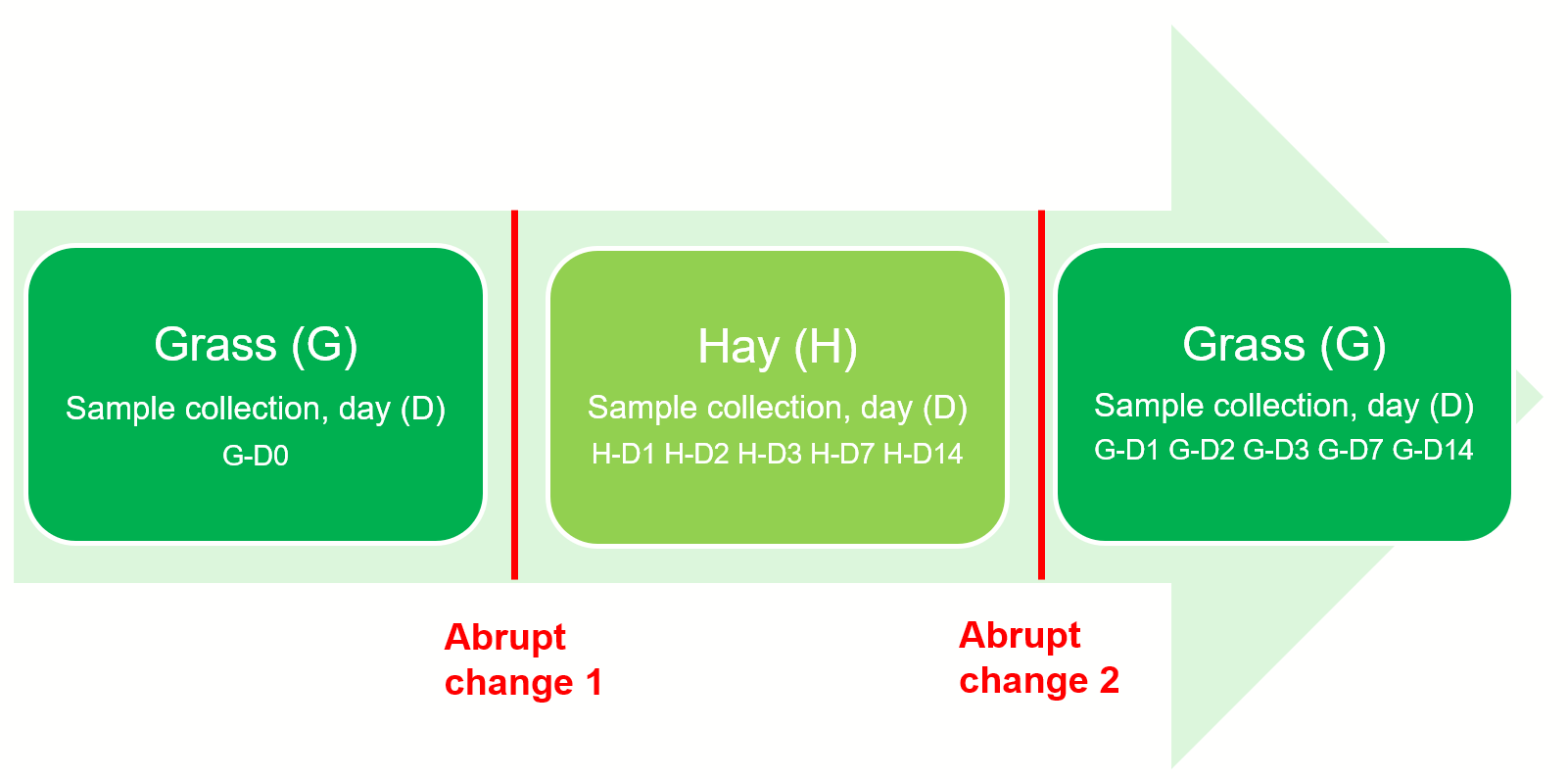
- The experimental trial involved two 14-day periods and included six adult Welsh Section A gelding ponies. Prior to the study, the ponies grazed on the same pasture for a month, with the experiment starting in early summer. The dietary transitions were monitored, with day 0 marked as the last day on pasture before transitioning to stables.
- The experimental periods consisted of feeding 100% hay diet at 17.5 g/kg body weight during the first period and grazing exclusively on pasture (predominantly ryegrass sward) during the second period.
- Faecal samples were collected between 1330 h and 1630 h on specific days during each experimental period using a sterilized spatula to minimize environmental contamination. The samples were immediately frozen at -20°C for subsequent laboratory analysis.
- Principal Coordinate Analysis (PCoA) and Linear Discriminant Analysis Effect Size (LEfSe) were used to analyze the microbial composition.
Findings:
- Alpha-diversity metrics did not significantly differ between diets or sampling days, indicating no significant change in taxa numbers or evenness. “Taxa” refers the different groups of microbes.
- PCoA revealed clustering of fecal samples by dietary group in the first few days after dietary change, suggesting a rapid microbial community response.
- In this experiment, the presence of clusters in the PCoA plots indicates that the gut microbiota of the ponies exhibited distinct patterns depending on factors such as diet or experimental day. These clusters provide visual evidence that the microbial community compositions are different under different conditions. Identifying clusters helps researchers understand how changes in diet or other experimental variables impact the gut microbiota composition, providing insights into the dynamics of microbial communities in response to dietary shifts.
- Firmicutes and Bacteroidetes were dominant phyla, with the relative abundance varying depending on the diet and sampling day.
- Bacterial genera such as Lactobacillus showed increased abundance following abrupt dietary changes, indicating potential shifts in hindgut pH.
- Inter-horse variation in gut microbiota was observed, suggesting individual differences in microbial responses to dietary changes.

Discussion:
- The study suggests that sudden dietary transitions affect fecal microbial community structure in ponies, with rapid adaptation observed within the first few days.
- “Previous research suggests that horse gut microbiota can adapt in response to new diets quickly within 4–6 days. This is in agreement with the results of the current study where according to PCoA and LEfSe, most of the differences in microbial community structure were observed during the first 3 days after dietary change. These results suggest a rapid microbial community response.”
- The Firmicutes to Bacteroidetes ratio may be an important indicator of metabolic changes in the horse’s gastrointestinal tract.
- Environmental factors and individual horse traits may also influence microbial responses to dietary changes.
Limitations:
- The study had a small sample size and lacked a control group maintained on pasture, limiting the generalizability of the findings.
- Environmental factors such as temperature and pasture composition could have influenced microbial composition.
Implications:
- Understanding microbial responses to dietary changes in horses is important for optimizing digestive health and preventing metabolic disorders.
- Further research is needed to investigate specific microbial species and their roles in nutrient breakdown and metabolism in response to dietary changes.
Overall, the study highlights the dynamic nature of fecal microbial communities in response to dietary changes and underscores the importance of further research in this area to improve equine health and welfare. It would be great to see a similar study done with two feeds that differ more significantly than the grass and hay used in this study.
In the discussion, this study cites another1 that concluded: “The change between two silages with different crude protein content resulted in altered colonic bacterial counts within the first 24 h after the abrupt change was introduced. Moreover, days 7 to 22 after abrupt change were associated with a decrease in pH and an increase in volatile fatty acids concentration.”
References:
Main article: Garber A, Hastie P, McGuinness D, Malarange P, Murray JA. Abrupt dietary changes between grass and hay alter faecal microbiota of ponies. PLoS One. 2020 Aug 18;15(8):e0237869. doi: 10.1371/journal.pone.0237869. PMID: 32810164; PMCID: PMC7446798.
Full Article: https://journals.plos.org/plosone/article/file?id=10.1371/journal.pone.0237869&type=printable
- Muhonen S, Connysson M, Lindberg JE, Julliand V, Bertilsson J, Jansson A. Effects of crude protein intake from grass silage-only diets on the equine colon ecosystem after an abrupt feed change. J Anim Sci. 2008 Dec;86(12):3465-72. doi: 10.2527/jas.2007-0374. Epub 2008 Aug 1. PMID: 18676731. ↩︎